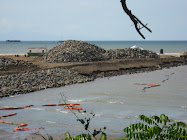
Local Newspapers reported that on September 11th, workers on the controversial 760 MW power plant (Trinidad Generation Unlimited) being built on Union Industrial Estate to supply power to the equally controversial Alutrint smelter were locked out by management. The power plant is being built by E Pihl & Sons, (pihl) a Danish company. The job was subcontracted to them by MAN FERROSTAAL (MF), a German Company. MF's majority shareholder is the Government of Abu Dabai.
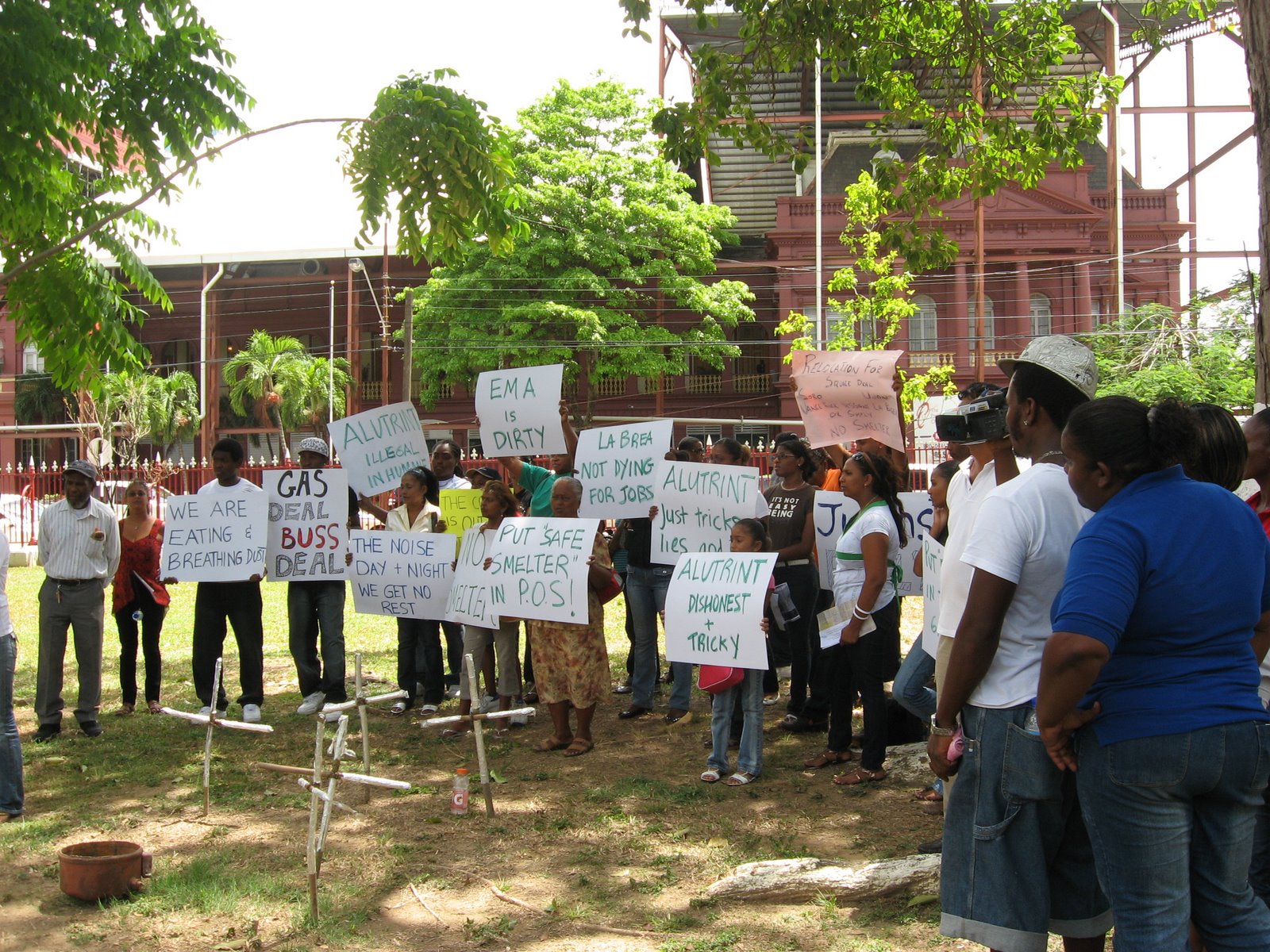
Locked out workers have pitched two tents outside the entrance to Union Industrial Estate. On the other side of the road is the anti-smelter camp. Earlier in the week, pihl warned workers against illegal industrial action. Workers are demanding better working conditions - including health and safety. According to one worker "within the past two weeks, four people have suffered injuries on the job. The company is saying that what we are doing is illegal, but as long as it is over health and safety issues, we are within our rights to strike,"
There is also concern over National Insurance deductions on their payslips. "We are supposed to be paying $134 a fortnight, but we are paying up to $400 a fortnight,". Workers are also claiming that they are not being paid properly for overtime.
Pihl had warned workers against illegal industrial action, stating that any breach of contract would "result in dismissal". One worker claimed "the project manager said he does not have to listen to our problems". Newspapers reported that pihl's Project Manager, Hansen, could not be reached by the press for comment.
Chinese workers on the adjacent Alutrint smelter were supposed to have downed tools since the June 16th Judgment when the High Court "quashed" Alutrint's Certificate of Environmental Clearance (CEC) issued by the Environmental Management Authority (EMA). Chinese workers have expressed frustration to local anti-smelter protestors camped out side.
Over this last week Alutrint has spent a fortune in 'Public-State' funds on public relations, seeking to convince the national population that their smelter poses no health risks (they remain mum on its economic viability). Harriet May-Phillips, (of 'SENES' a Canadian based consulting firm) and author of the very controversial Human Health and Ecological Risk Assessment (HEERA) which formed part of Alutrint's CEC submissions has been on the radio (several stations) every day this week. Alutrint is planning a big fete in La Brea this weekend for the 'community' where rum will flow, noise will make, flags will wave and no doubt many a young man will stumble home in a drunken stupor.
For the record, the EMA hired Jaques Whitford (a consulting firm also from Canada) to perform a supposedly 'independent' review of the HEERA prepared by SENES. Had the EMA bothered to look, they would have found that SENES and JW have a history of close collaboration with each other.
Concerned citizens of Trinidad and Tobago do not accept that JW can with impartiality and neutrality, professionally review the work of of SENES. The internet makes for interesting reading on a paper mill in Canada where these two companies were involved in reviewing each others work.
In any event, the EMA remains at fault for fragmenting and "staggering" the CECs for the smelter, power plant and port facilities. These are essential components of Alutrint's Smelter Complex. An integrated Environmental Impact Assessment should have been carried out for this infrastructure. We the People of Trinidad & Tobago are left with the vexing situation of a 'quashed smelter', a 'striking power plant' and a port still under construction. What a mess! Undeterred however, the 'State' continues to say 'smelta coming'. We are on-the-ground 'playing for change'.
Showing posts with label EMA. Show all posts
Showing posts with label EMA. Show all posts
Friday, September 18, 2009


Tuesday, July 14, 2009
Smelter appeal to be heard in September (T&T Guardian Newspaper, 14/07/09)
by Francis Joseph
The appeal against the construction of the aluminium smelter plant at La Brea has been deemed urgent and will be heard sometime in September. Madame Justice Alice Yorke-Soo Hon, presiding in the Court of Appeal, also ordered that the Attorney General be made a party to the appeal. On June 16, Madame Justice Mira Dean-Armorer, presiding in the Port-of-Spain High Court, granted an order of certiorari, quashing the decision of the Environmental Management Agency (EMA) to issue a certificate of environmental clearance on April 2, 2007, to Alutrint, the developer.
Dean-Armorer said, “It is my view that the decision of the defendant, EMA, was procedurally irregular, irrational, and made without regard to the relevant consideration, that is to say, the consideration of the cumulative impact of the three related projects—the power plant, the aluminium complex, and the port facility.” Dean-Armorer remitted the matter to the EMA for consideration, meaning that the EMA must go over the entire process for the construction of the smelter plant. The case was filed by three public interest groups, People United Respecting the Environment (Pure), Rights Action Group (RAG) and the Smelter Karavan.
But the EMA did not appeal against the three groups. The EMA appealed against PURE, although lawyers for the three groups appeared at the Court of Appeal yesterday. PURE was represented by Marina Narinesingh. The first application was for the Attorney General to become a party to the appeal, although the AG asked that he would not be liable for costs at the end of the matter. Representing the AG were Russell Martineau SC and Stuart Young. Alutrint, which was represented by Deborah Peake SC and Kerwyn Garcia, sought and was granted a stay of the payment of costs. Ian Benjamin represented EMA.
There was no application to stay the judgment of Dean-Armorer. The EMA asked that the appeal be deemed urgent. Soo Hon agreed that the appeal be deemed urgent, and that the appeal be expedited and be fixed on a date in September. The 2008-2009 law terms ends on July 31 and the new law term will open on September 21 with the ceremonial parade.
The appeal against the construction of the aluminium smelter plant at La Brea has been deemed urgent and will be heard sometime in September. Madame Justice Alice Yorke-Soo Hon, presiding in the Court of Appeal, also ordered that the Attorney General be made a party to the appeal. On June 16, Madame Justice Mira Dean-Armorer, presiding in the Port-of-Spain High Court, granted an order of certiorari, quashing the decision of the Environmental Management Agency (EMA) to issue a certificate of environmental clearance on April 2, 2007, to Alutrint, the developer.
Dean-Armorer said, “It is my view that the decision of the defendant, EMA, was procedurally irregular, irrational, and made without regard to the relevant consideration, that is to say, the consideration of the cumulative impact of the three related projects—the power plant, the aluminium complex, and the port facility.” Dean-Armorer remitted the matter to the EMA for consideration, meaning that the EMA must go over the entire process for the construction of the smelter plant. The case was filed by three public interest groups, People United Respecting the Environment (Pure), Rights Action Group (RAG) and the Smelter Karavan.
But the EMA did not appeal against the three groups. The EMA appealed against PURE, although lawyers for the three groups appeared at the Court of Appeal yesterday. PURE was represented by Marina Narinesingh. The first application was for the Attorney General to become a party to the appeal, although the AG asked that he would not be liable for costs at the end of the matter. Representing the AG were Russell Martineau SC and Stuart Young. Alutrint, which was represented by Deborah Peake SC and Kerwyn Garcia, sought and was granted a stay of the payment of costs. Ian Benjamin represented EMA.
There was no application to stay the judgment of Dean-Armorer. The EMA asked that the appeal be deemed urgent. Soo Hon agreed that the appeal be deemed urgent, and that the appeal be expedited and be fixed on a date in September. The 2008-2009 law terms ends on July 31 and the new law term will open on September 21 with the ceremonial parade.
Wednesday, July 8, 2009
EMA Appeals Judgement (reported Guardian Newspaper 8th July, 2009)
The Environmental Management Authority (EMA) has appealed the judgment of Justice Mira Dean-Armorer, which quashed the decision to grant a certificate of Environmental Clearance (CEC) to Alutrint for construction of an aluminium smelter in La Brea.
The notice was filed on Monday against the June 15 judgment. A release issued yesterday by the EMA said, “The EMA through a notice filed on July 6, has appealed against the decision by the EMA to grant a CEC to Alutrint for construction of an aluminium smelter in La Brea.”
The EMA said it was acting independently on behalf of the public by “balancing environmental considerations with economic ones.” It defended its decision to “grant the CEC after thorough and qualified review over a period of more than two years, involving consultation with the public.”
The EMA further stated that it was satisfied it had discharged its statutory duties, took appropriate precautionary measures to prevent serious and irreversible damage to the environment, “and the learned judge erred in reaching her conclusions.”
The notice was filed on Monday against the June 15 judgment. A release issued yesterday by the EMA said, “The EMA through a notice filed on July 6, has appealed against the decision by the EMA to grant a CEC to Alutrint for construction of an aluminium smelter in La Brea.”
The EMA said it was acting independently on behalf of the public by “balancing environmental considerations with economic ones.” It defended its decision to “grant the CEC after thorough and qualified review over a period of more than two years, involving consultation with the public.”
The EMA further stated that it was satisfied it had discharged its statutory duties, took appropriate precautionary measures to prevent serious and irreversible damage to the environment, “and the learned judge erred in reaching her conclusions.”
Thursday, July 2, 2009
La Concerned Citizens United Respond to Comments by Prime Minister in Newsday on 1st July, 2009
Dear Editor, In your July 1 article “PM: Smelter Work Won’t Stop”, The Prime Minister’s statements about the High Court ruling on the Alutrint Smelter CEC is misleading in several regards.
The Prime Minister states that that the court had objected to the process under which the CEC was granted and not to the smelter plant itself. The article has the effect of giving the false impression that the Court case was about the merits of the smelter and that, having considered these merits, “the courts did not object to the smelter, the courts just said the process needed to be beefed up in a certain area” and that’s what they were “seeking to do now”. We wish to clarify for the public that the Court case was never about the merits of the smelter. It was about the process followed by the EMA in granting permission to Alutrint. In this regard the judge found that the EMA acted in a manner that was “procedurally irregular” and “irrational”.
The real significance of this judgment is not that the EMA needed to “beef up” its process. The significance is that the courts found that towards the end, the process had been corrupted. The EMA was found to have acted “irregularly” not only with respect to the law but also with respect to its own track record on handling the CEC case. In the end, the battery of high powered lawyers representing the EMA, Alutrint, and The Attorney General, failed to satisfy the court that the EMA did its job with regard to its purpose as an agency and the laws of our country.
The Court found that the EMA had been following procedures all along for about 18 months but suddenly around March of 2007 their process became “irregular”. The EMA failed to consider the environment and human health effects of the Spent Pot Liners which the experts had identified as the type of waste that posed the greatest threat of harm to human health. The judge considered this failure “outrageous” given the responsibility that our country has placed in the EMA’s hands. The judge then found that the report on the cumulative impact of components of the smelter complex: the power plant, port, and smelter was “shrouded in secrecy”. In addition, there was the most abnormal behavior of the EMA, which received the report on March 27, 2009 and without proper independent expert review or public review, issued the CEC to Alutrint a mere five days later on April 2, 2007 (a weekend included).
Given the findings of the Court on the conduct of the EMA, it is not surprising, that the Prime Minister has stated that the EMA “is moving as fast as possible” to get Alutrint back on track. The Prime Minister, and apparently the EMA, before considering the serious matters of human health that were neglected along with the public’s views on these matters, know the conclusion will be a grant of a CEC to Alutrint.
This serves to fortify our view that the EMA lacks both the integrity and intention to conduct an independent CEC process. Aside from its failure in the CEC process for Alutrint, the EMA has ignored our complaints for about four years about serious effects of activities of the Union Industrial Estate on the environment and our health. The EMA has allowed the NEC to violate the CEC it granted for the Union Industrial Estate. You just have to come to Sobo, Vessigny, and Square Deal to see how we are covered in dust, the sickness, and the destruction of the Vessigny River. The EMA has allowed Alutrint to violate its CEC with respect to commencing works before settling relocation of residents that fall within the buffer zone. This Agency has been nothing short of hostile and blatantly unconcerned about our communities and the environment.
The EMA, Alutrint, and the NEC would have to be taking God out of their thoughts to come back here to La Brea for the planned pretense of “beefing up” or conducting a new CEC process. La Brea Concerned Citizens United
The Prime Minister states that that the court had objected to the process under which the CEC was granted and not to the smelter plant itself. The article has the effect of giving the false impression that the Court case was about the merits of the smelter and that, having considered these merits, “the courts did not object to the smelter, the courts just said the process needed to be beefed up in a certain area” and that’s what they were “seeking to do now”. We wish to clarify for the public that the Court case was never about the merits of the smelter. It was about the process followed by the EMA in granting permission to Alutrint. In this regard the judge found that the EMA acted in a manner that was “procedurally irregular” and “irrational”.
The real significance of this judgment is not that the EMA needed to “beef up” its process. The significance is that the courts found that towards the end, the process had been corrupted. The EMA was found to have acted “irregularly” not only with respect to the law but also with respect to its own track record on handling the CEC case. In the end, the battery of high powered lawyers representing the EMA, Alutrint, and The Attorney General, failed to satisfy the court that the EMA did its job with regard to its purpose as an agency and the laws of our country.
The Court found that the EMA had been following procedures all along for about 18 months but suddenly around March of 2007 their process became “irregular”. The EMA failed to consider the environment and human health effects of the Spent Pot Liners which the experts had identified as the type of waste that posed the greatest threat of harm to human health. The judge considered this failure “outrageous” given the responsibility that our country has placed in the EMA’s hands. The judge then found that the report on the cumulative impact of components of the smelter complex: the power plant, port, and smelter was “shrouded in secrecy”. In addition, there was the most abnormal behavior of the EMA, which received the report on March 27, 2009 and without proper independent expert review or public review, issued the CEC to Alutrint a mere five days later on April 2, 2007 (a weekend included).
Given the findings of the Court on the conduct of the EMA, it is not surprising, that the Prime Minister has stated that the EMA “is moving as fast as possible” to get Alutrint back on track. The Prime Minister, and apparently the EMA, before considering the serious matters of human health that were neglected along with the public’s views on these matters, know the conclusion will be a grant of a CEC to Alutrint.
This serves to fortify our view that the EMA lacks both the integrity and intention to conduct an independent CEC process. Aside from its failure in the CEC process for Alutrint, the EMA has ignored our complaints for about four years about serious effects of activities of the Union Industrial Estate on the environment and our health. The EMA has allowed the NEC to violate the CEC it granted for the Union Industrial Estate. You just have to come to Sobo, Vessigny, and Square Deal to see how we are covered in dust, the sickness, and the destruction of the Vessigny River. The EMA has allowed Alutrint to violate its CEC with respect to commencing works before settling relocation of residents that fall within the buffer zone. This Agency has been nothing short of hostile and blatantly unconcerned about our communities and the environment.
The EMA, Alutrint, and the NEC would have to be taking God out of their thoughts to come back here to La Brea for the planned pretense of “beefing up” or conducting a new CEC process. La Brea Concerned Citizens United
Friday, May 8, 2009
Technical Article by Physicist, Dr. Peter Vine, Concludes Aluminium Smelter Complex Air Quality Modelling is "Erroneous"

ABSTRACT. Air dispersion modelling (ADM) was required by the Environmental Management Authority (EMA) of Trinidad and Tobago for an aluminium smelter complex, an iron and steel plant and a chlor-alkali plant.
This article critiques the outputs of the modelling. For the aluminium smelter complex, wind roses which were produced by the MM5 model, and then used in the CALPUFF ADM, underestimated calm periods 20-fold compared with actual observations.
For the iron and steel plant and for the chlor-alkali plant, the ADMs (ISC3 and AERMOD) produced apparently unjustifiable bicycle spoke patterns instead of concentric loops of iso-concentration around the source. It is concluded that the predictions of airborne emission concentrations were erroneous and that the Certificates of Environmental Clearance (CECs) for the plants must be withdrawn.
For full Article by Dr. Vine please visit:
Thursday, April 2, 2009
Proof of Anti-Sustainable Development - The Deregulation of Quarries and the Northern Range
In April 2009, Trinidad & Tobago (T&T) is hosting the 5th Summit of the Americas with a theme of “environmental sustainability”.
The Truth Drummers say that any declarations signed committing to environmental sustainability would be hypocritical because T&T is depleting its energy resources as fast as is technologically possible to meet the demands of the USA, foreign corporations and a handful of local elites. The price of this ‘gas stripping’ remains unknown (“in an abundance of water the fool is thirsty...Rat Race”, Bob Marley).
This posting seeks to demonstrate that T&T is on an anti-sustainable path by examining the quarrying sector.
Before we begin, let us accept the definition of sustainable development in its broadest possible terms - as meeting the needs of the present generation without compromising the ability of future generations to meet their own needs.
Let us also remind ourselves that the World Summit for Sustainable Development (Rio plus 10, Johannesburg, 2002) declared that “there must be at the domestic level, sound environmental, social and economic policies, and democratic institutions responsive to the needs of the people.”
Let us start our demonstration with an overview of the role of Environmental Management Authority (EMA) which began operations in June 1995 with start up money from the World Bank and a mandate to “write and enforce laws and regulations for environmental management, to educate the public about the nation's environmental issues and to control and prevent pollution, as well as conserve natural resources.” (EMA website). The principle environmental legislation enacted so far is the Environmental Management Act of 2000.
The EMA’s National Environmental Policy (revised in September, 2005) states “Moreover, the development of the petroleum and petrochemical sector has expanded to the extent that T&T is now the largest supplier of natural gas to the USA and the number one exporter of ammonia in the world. These developments have given the country global recognition and attention. The Government is therefore duty bound to ensure that T&T finds the right balance between economic development and environmental conservation.”
This Policy recognizes the environment as “an essential pillar of economic and social development and consequently environmental sustainability is a key objective of economic development planning”...in formulating this Policy...“the government focused on the sustainable management of the country’s environmental assets rather than the narrower concept of environmental protection, which tends to bring into conflict environment and development. The Policy therefore assures that economic development is not undermined by the unsustainable use of our environmental assets.”
The EMA is the focal point of development decision making since one of its functions is to issue Certificates of Environmental Clearance (CEC) to new development projects that may impact the environment. Where environmental impacts are expected to be significant the developer is required to engagethe services of a suitable consultant to undertake an Environmental Impact Assessment (EIA).
'Mining' (quarrying) was included in the ‘List of Designated Activities’ (Activity 23, established by Order 103 in 2001) which under the CEC Rules required an EIA.
The EMA’s 2004 State of the Environment Report is an assessment of the contribution of ecosystem services of the Northern Range (NR) of Trinidad and Tobago to human well-being. "It is the result of a remarkable jointly lead pro bono collaboration between several civic society organizations and private individuals with the EMA and employees of several government Ministries and agencies acting in their personal capacities” (former Chairman of the Board Dr. John Agard).
This Report is important because 80% of our drinking water comes off the NR – a mountainous region running east-to-west along the north coast, covering about 25% of Trinidad’s land area and obviously the most important watershed on the island. The findings of the EMA's Report include:
The Truth Drummers say that any declarations signed committing to environmental sustainability would be hypocritical because T&T is depleting its energy resources as fast as is technologically possible to meet the demands of the USA, foreign corporations and a handful of local elites. The price of this ‘gas stripping’ remains unknown (“in an abundance of water the fool is thirsty...Rat Race”, Bob Marley).
This posting seeks to demonstrate that T&T is on an anti-sustainable path by examining the quarrying sector.
Before we begin, let us accept the definition of sustainable development in its broadest possible terms - as meeting the needs of the present generation without compromising the ability of future generations to meet their own needs.
Let us also remind ourselves that the World Summit for Sustainable Development (Rio plus 10, Johannesburg, 2002) declared that “there must be at the domestic level, sound environmental, social and economic policies, and democratic institutions responsive to the needs of the people.”
Let us start our demonstration with an overview of the role of Environmental Management Authority (EMA) which began operations in June 1995 with start up money from the World Bank and a mandate to “write and enforce laws and regulations for environmental management, to educate the public about the nation's environmental issues and to control and prevent pollution, as well as conserve natural resources.” (EMA website). The principle environmental legislation enacted so far is the Environmental Management Act of 2000.
The EMA’s National Environmental Policy (revised in September, 2005) states “Moreover, the development of the petroleum and petrochemical sector has expanded to the extent that T&T is now the largest supplier of natural gas to the USA and the number one exporter of ammonia in the world. These developments have given the country global recognition and attention. The Government is therefore duty bound to ensure that T&T finds the right balance between economic development and environmental conservation.”
This Policy recognizes the environment as “an essential pillar of economic and social development and consequently environmental sustainability is a key objective of economic development planning”...in formulating this Policy...“the government focused on the sustainable management of the country’s environmental assets rather than the narrower concept of environmental protection, which tends to bring into conflict environment and development. The Policy therefore assures that economic development is not undermined by the unsustainable use of our environmental assets.”
The EMA is the focal point of development decision making since one of its functions is to issue Certificates of Environmental Clearance (CEC) to new development projects that may impact the environment. Where environmental impacts are expected to be significant the developer is required to engagethe services of a suitable consultant to undertake an Environmental Impact Assessment (EIA).
'Mining' (quarrying) was included in the ‘List of Designated Activities’ (Activity 23, established by Order 103 in 2001) which under the CEC Rules required an EIA.
The EMA’s 2004 State of the Environment Report is an assessment of the contribution of ecosystem services of the Northern Range (NR) of Trinidad and Tobago to human well-being. "It is the result of a remarkable jointly lead pro bono collaboration between several civic society organizations and private individuals with the EMA and employees of several government Ministries and agencies acting in their personal capacities” (former Chairman of the Board Dr. John Agard).
This Report is important because 80% of our drinking water comes off the NR – a mountainous region running east-to-west along the north coast, covering about 25% of Trinidad’s land area and obviously the most important watershed on the island. The findings of the EMA's Report include:
- 33 quarries operating in the NR
- the environmental effects of uncontrolled quarrying create major problems for persons who live in or use the immediate environs of the quarries
- NR watersheds are becoming more degraded
- declining trend in fresh water fish catch and
- quarry operations are dictated by business economics to the exclusion of environmental situation…and aggravated by poor level of control over the industry
The Report goes on to state “the Water and Sewage Authority (WASA) spends $TT 13.4M per month (Million) on desalination water which accounts for 10% of total supply and….. if WASA had to substitute the surface water supplied by the Northern Range for desalinated water, this would cost “$TT 107M /month.”
The Report recommended:
- Accelerate revision of the Quarry policy and increase threshold for good practice in this sector
- Give priority to rehabilitation and restoration where possible to abandoned quarry sites to arrest erosion and run-off
- Disallow further quarrying in the NR and if necessary import aggregate
- Bring into the regulatory framework quarries that pre-existed the EM Act
The Report also noted that “the situation in the Northern Range could be helped if there was a champion of the issues at the political level.”
Switching now to the related Ministry of Energy and Energy Industries, which is responsible for issuing mining (quarry) licenses. Their 2005 draft Green Paper on Quarry Policy states that “the Trinidad and Tobago quarry industry in 2004, comprised fifty-six (56) active quarries of which thirty-eight (38) are sand and gravel quarries. Of the sand and gravel quarries twelve (12) were operating illegally.
The Green Paper recognizes that “growth and development of the energy sector and that of the construction sector in Trinidad and Tobago are highly correlated” and that “the current high level of growth in the construction sector is reflected in soaring demand for quarry materials and has stimulated a high degree of activity in the sector.”
Quoting further from the Policy: “Possible quarry reserves as at January 1, 2004 in Trinidad and Tobago were 2,530 million cubic yards spread over 8,430 acres. The lack of proper legal arrangements and other shortcomings in the administration of the sector became more obvious as it led to an unprecedented spate of illegal quarrying..."
Based on data included in the Green Paper, over 90% of quarrying activity takes place in the Northern Range.
The major quarry Policy goal stated is to “promote sustainable development of the quarry industry of Trinidad and Tobago for the benefit of its people in an environmentally sound manner and consistent with Government’s macroeconomic policy.”
The Green Paper acknowledges the following shortcomings in the sector:
- absence of regulations to grant quarry licenses
- ambiguity with respect to the procedures for assigning and terminating licenses
- conflicts with existing legislative provisions e.g. the Environmental Management Authority Act
- ineffective and deficient regulatory control
- inappropriate legislative mechanisms and Institutional weaknesses
- currently the quarry industry in Trinidad and Tobago is deluged with environmental problems. These are being addressed as a matter of urgency
That is the background. Now let us see what happened next...
Astonishingly to the naive, in 2007 and 2008, two successive Ministers with Environmental portfolios reversed the Certificate of Environmental Clearance (CEC) Rules to ensure that new quarry applications would no longer be subject to any form of social and environmental assessment or scrutiny! (Presumably not the "political level champion sought by EMA).
The first reversal or 'anti-sustainable development blow' was made by former Minister of Public Utilities and Environment, Penelope Beckles (she is now Speaker of House) – through Legal Notice 164, July 2007. The second anti-sustainable development blow was made by the current Minister of Planning, Housing and Environment, Dr. Emily Dick-Forde – through Legal Notice 186, November 2008).
Penelope Beckles’ Order made sure that no application for quarries less than 150 acres would be subject to an Environmental Impact Assessment (EIA)! (no quarry is as big as this mind you). The result was impressive, by the end of 2007 there were 17 new applications for quarries and a withdrawal of a pending application, submitted before the Order (for a quarry in Ortinola, Acono, in the Maracas Valley, in the centre of the Northern Range).
In her haste to open the quarrying flood gates, however, ex-Minister Beckles overlooked another ‘Designated Activity’ in the CEC Rules, (8c) one for “ the clearing, excavation, grading or land filling of any area with a gradient of 1:4 or more” which also required that an Environmental Impact Assessment be performed. But no worries, up stepped Minister Dick-Ford to take care of any residual 'sustainability loopholes'.
Her December 2008 Order exempted quarrying activity from any such assessment. Again, these 'environmental hating' actions might appear astonishing to the naive but are par for the course, if one is following the leader carefully. Of course Minister Dick-Forde's Order is ludicrous as essential quarry operations are "clearing, grading, excavating and backfilling!"
Conclusion
Successive Ministers responsible for the “environment” have sacrificed declared policy and sustainability goals to serve perceived economic gains in the energy and construction sectors. The consequences of this sacrifice are profound; not only are the resources of the Northern Range being denied to future generations, not only are people living there right now suffering from reduced quality of life, but the integrity of the supposed democratic process and trust in Government institutions to look after the well being of present and future generations, are also shattered.
Truth Drummers have used the quarry sector to demonstrate ‘anti-sustainable development' with far reaching and destabilizing implications. The hypocrisy of T&T’s Government signing a ‘Declaration of Commitment’ to sustainability at the up-coming Summit while doing the opposite at home is why we will Drummit to the Summit.
Subscribe to:
Posts (Atom)