Friday, April 17, 2009


Monday, April 13, 2009
An Abuse of Power - Rushing the Gas: Energy Insecurity in a Binge Economy
1 MW (megawatt) = 1 million joules per second = unit of electrical power generation
In Trinidad & Tobago the total rate of electricity generation is presently 1100 MW.
The existing steel mill (Arcellor-Mittal) uses 240 MW.
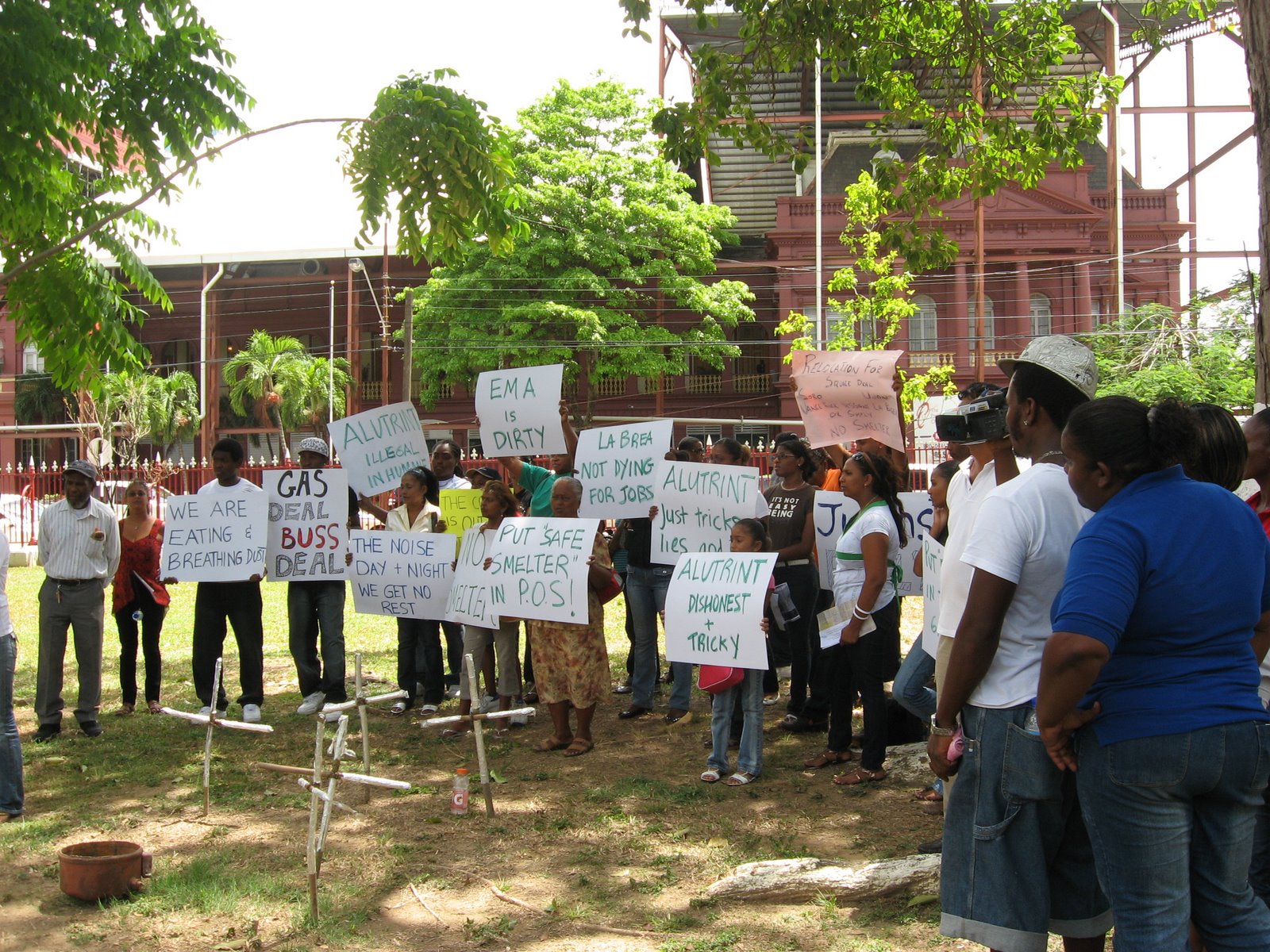
The 125 000 t/yr (tonnes per year) Alutrint aluminium smelter proposed to be built by Chinese at La Brea would use 240 MW. They are stealthily seeking to double output to 250 000 t/yr. This would require 480 MW.
A new power plant proposed for La Brea which has been granted environmental clearance by the Environmental Management Authority (EMA) is to have a capacity of 720 MW. This would serve Alutrint and other users.
The Aluminium Company of America (ALCOA) applied for environmental clearance for a 341 000 t/yr smelter at Chatham in South West Trinidad, with a statement that this would require 580 MW. T&T Prime Minister notified public in December 2006 that plans had been suspended for the smelter at Chatham.
The Essar Steel Mill proposed for Claxton Bay and approved by Environmental Management Authority would require 202 MW with space left for an additional plant requiring 240 MW.
What the above shows is that the proposed additional heavy gas based industry would require a doubling of electricity production. In T&T all electricity is generated from combustion of our natural gas. Why should we double gas consumption for heavy polluting and gas consuming industries?
Who is benefiting? Who is losing? There is no transparency in the gas supply deals (EITI rejected, see earlier post). There is no cost-benefit analysis in the Certificate of Environmental Clearance (CEC) decision making process administered by the Environmental Management Authority (EMA).
We should be looking at low energy demanding industry with low environmental impact and high valued outputs.
Growing the National Carbon Footprint - Carbon Dioxide
Essar Steel’s approved plant would produce an additional 900 000 t/yr of CO2 initially, rising to 1 870 000 t/yr.
Adding 760 000 t/yr of CO2 production from a 240 MW captive power plant for Essar; gives us a total of 2 630 000 t/yr of CO2 .
If Essar pursues its declared interest in putting up a second mill similar to the first, its CO2 emissions would double to 5 260 000 t/yr.
The 720 MW power plant proposed for La Brea would generate 2 300 000 t/yr of CO2 . In addition, Alutrint would release greenhouse gases from the smelter rooms at a rate of up to 2 tonnes of CO2 equivalent per tonne of aluminium produced, i.e. 250 000 t/yr of CO2 equivalent.
ALCOA would cause release of as much as 2 760 000 t/yr of CO2 equivalent from smelter rooms and electricity generation.
Total additional CO2 from the proposed plants, excluding the future extensions, is estimated as an additional ‘cool’ 25%. This is global warming T&T Vision 2020 style.
What National Food Crop Farmers Association Want
Fix our farmers who have provided this country with cheap food for decades
Fix our access roads and bridges
Provide an efficient marketing system with security fr farmers and consumers
Fix our land titles and lease agreements
Fix these things now and in two years review our performance
National Food Crop Farmers Association " A Growing Food Crisis for the Poor"
(Press release 2008)
It has now become a public debate whether there is a food crisis or not. It is the view of the NFFA that there is a food crisis which is projected to become worse by the end of the year if government intends to increase the cost of fuel.
The food crisis is certainly not going to be felt by the more privileged in society but certainly when it comes to the poor and the minimally paid workers, we have to be honest that it will be more of a burden.
The term food crisis in our opinion can be either a shortage of food or alternatively high prices for food, beyond the reach of the poor and average class in society. The view that we are not starving as a population to justify there is no food crisis is an outdated view in this modern era.
The blatant fact is that food prices are increasing and the purchasing power of the citizenry has declined drastically. The unavailability of basic food stuff such as flour and rice, two main staples which are a fundamental part of our food reveals that we have a problem.
Although we cannot produce wheat for flour, we can certainly produce rice. However, as with everything else concerning agriculture there seems to be no urgency in dealing with matters concerning our local food security. There seems to be a major hindrance to implementation.
The NFFA would like to remind the population that in the dry season food production is at its highest and as such prices are at its lowest, with the onset of the rainy season, reduced production attributed to floods, pests and diseases would mean higher prices for the cost of food, further reducing our purchasing power and if not a food crisis, then personal financial crisis hence, the less food one can purchase - same difference. Food crisis, if not for the rich, then for the poor. Yes food crisis for the poor.
Saturday, April 11, 2009
Water - Need or Right?
Activists from the People’s Water Forum, an alternative formation representing rural poor, the environment and organized labor, slammed the official event as a non-inclusive, corporate-driven fraud pushing for water privatization and called for a more open, democratic and transparent forum.
The forum, which is organized every three years by the French-based World Water Council, is funded in large part by the water industry. The forum opened with Turkish police firing tear gas and detaining protesters, who were shouting “water for life, not for profit.”
The final non-binding communiqué from the official forum describes access to water as a “basic human need” rather than a ‘human right’, despite efforts by dissenting Latin American countries...” (Democracy Now, 23 Mar 09)
“Recognizing water as a basic human right would mean equating it with other fundamental rights already observed by the United Nations, defining it as an unalienable right, and obligating most governments to ensure this for their entire populations.
Bolivia, Chile, Cuba, Ecuador, Guatemala, Honduras, Panama, Paraguay, Uruguay and Venezuela refused to sign the final declaration of this year’s water forum in Istanbul, but instead an alternative declaration that did recognize access to water as a basic human right”.
According to Maude Barlow, the senior adviser on water issues to the United Nations General Assembly, in an interview on New York-based radio program ‘Democracy Now’, “The World Water Forum is bankrupt of new ways to address the growing water crisis in the world, because they have maintained an adherence to an ideology that is not working, that has dramatically failed,”.
In a press conference, Bolivian Environment Minister René Orellana said this declaration “ignores native peoples, collective rights to water, local or community systems of water management, but above all, there was no political will to include any change to the text.”The 25 nations that signed an alternative declaration made a call for future debates over water with greater participation, social inclusion and democratic values. (Latinamerica Press, 2009).
According to the Economic Commission for Latin America and the Caribbean, “46 million of the 580 million inhabitants in the region lack access to drinking water, and 121 million do not have sanitation”.
See below for Trinidad and Tobago's position on water...
Water is a ‘basic need’? Water is a ‘basic right’? Nah man, here in T&T water is a 'basic profit'...
During a post Cabinet briefing on September 18, Abdul-Hamid noted the Government would bring in an “advisor” to aid in the setting up of five new plants. “First of all, we propose to hire an independent procurement expert with experience in management, construction, operating and owning and maintaining desalination plants, as well as waste-water treatment plants, drinking water treatment plants and construction of water-transmission networks.”
Hamid assured that “companies were being sought to design, build, own and operate the desalination plants with the companies then selling water to Government. “We sent out requests for information…we expect to have our contracts awarded somewhere in March of 2009,” Abdul- Hamid said.
A worker, who spoke on the basis of anonymity, boasted that water produced by the desalination plant was capable of producing water which exceeds World Health Organisation (WHO) standards. [strange, how this anonymous ‘worker’ is unconcerned about his ‘needs’ and ‘rights’ to water or his future job prospects and increase in water bill].
He [the worker] explained further “that water purity standards, measured on the nephelolometric turbidity units (NTU) scale (which is a universal water standard set out by the WHO) usually rank potable water as having an ntu rating of below five units”.
He [the worker] said the water produced by the new desalination plant was capable of producing water at below .15 ntu. “The final quality of this water is better than most bottled water,” the worker boasted. [the worker “boasted”?] – Truth Drummers wonder how the Korean desalination plant water quality squares up with the once pristine and mineral rich water of the Northern Range, before becoming silted up with quarry run-off. Read below our proof of ‘anti-sustainable development’ using the quarry and water sectors as evidence…
A BIT for a GAS RUSH License looks like this...
Treatment of investment: requires that the treatment of foreign investments is no less favorable than that accorded to domestic investments ("national treatment").
Expropriation: prohibits expropriation or nationalization of an investment without just compensation.
Compensation for damages: requires national treatment for investments suffering losses from war and similar events.
Transfers: permits financial transfers relating to investments to be made freely and without delay into and out of each country's territory.
Performance requirements: prohibits performance requirements as a condition for investment.
Alien entry: liberalizes certain visa regimes relating to entry, sojourn and employment of aliens for establishment and operation of investments of substantial capital amounts.
Dispute settlement: provides for dispute resolution alternatives, including binding arbitration.
Economic reform, and trade and investment liberalization have led to substantial foreign investment inflows. The U.S. continues to be the single largest foreign investor in Trinidad and Tobago. Other large foreign investors include the United Kingdom (petroleum and financial services), Canada (petroleum, petrochemicals and financial services), Germany (petrochemicals), India (iron/steel), Norway (petrochemicals), Australia (petroleum) and Spain (petroleum). The bulk of foreign investment is in the country’s lucrative energy-based sectors.
(taken from website of US Department of State, 2005)
Read on the results are impressive...
Friday, April 10, 2009
Heads of States Reject Transparency Recommendation by Civil Society
Unsurprisingly, this recommendation was left out of the draft Declaration of Commitment to be signed by the Heads of State. The EITI aims to strengthen governance by improving transparency and accountability in the extractives sector. The EITI sets a global standard for companies to publish what they pay and for governments to disclose what they receive. Why would the host State Trinidad & Tobago want to avoid global transparency standards in the oil and gas sector? Because a “GAS RUSH” is on…
Thursday, April 2, 2009
Proof of Anti-Sustainable Development - The Deregulation of Quarries and the Northern Range
The Truth Drummers say that any declarations signed committing to environmental sustainability would be hypocritical because T&T is depleting its energy resources as fast as is technologically possible to meet the demands of the USA, foreign corporations and a handful of local elites. The price of this ‘gas stripping’ remains unknown (“in an abundance of water the fool is thirsty...Rat Race”, Bob Marley).
This posting seeks to demonstrate that T&T is on an anti-sustainable path by examining the quarrying sector.
Before we begin, let us accept the definition of sustainable development in its broadest possible terms - as meeting the needs of the present generation without compromising the ability of future generations to meet their own needs.
Let us also remind ourselves that the World Summit for Sustainable Development (Rio plus 10, Johannesburg, 2002) declared that “there must be at the domestic level, sound environmental, social and economic policies, and democratic institutions responsive to the needs of the people.”
Let us start our demonstration with an overview of the role of Environmental Management Authority (EMA) which began operations in June 1995 with start up money from the World Bank and a mandate to “write and enforce laws and regulations for environmental management, to educate the public about the nation's environmental issues and to control and prevent pollution, as well as conserve natural resources.” (EMA website). The principle environmental legislation enacted so far is the Environmental Management Act of 2000.
The EMA’s National Environmental Policy (revised in September, 2005) states “Moreover, the development of the petroleum and petrochemical sector has expanded to the extent that T&T is now the largest supplier of natural gas to the USA and the number one exporter of ammonia in the world. These developments have given the country global recognition and attention. The Government is therefore duty bound to ensure that T&T finds the right balance between economic development and environmental conservation.”
This Policy recognizes the environment as “an essential pillar of economic and social development and consequently environmental sustainability is a key objective of economic development planning”...in formulating this Policy...“the government focused on the sustainable management of the country’s environmental assets rather than the narrower concept of environmental protection, which tends to bring into conflict environment and development. The Policy therefore assures that economic development is not undermined by the unsustainable use of our environmental assets.”
The EMA is the focal point of development decision making since one of its functions is to issue Certificates of Environmental Clearance (CEC) to new development projects that may impact the environment. Where environmental impacts are expected to be significant the developer is required to engagethe services of a suitable consultant to undertake an Environmental Impact Assessment (EIA).
'Mining' (quarrying) was included in the ‘List of Designated Activities’ (Activity 23, established by Order 103 in 2001) which under the CEC Rules required an EIA.
The EMA’s 2004 State of the Environment Report is an assessment of the contribution of ecosystem services of the Northern Range (NR) of Trinidad and Tobago to human well-being. "It is the result of a remarkable jointly lead pro bono collaboration between several civic society organizations and private individuals with the EMA and employees of several government Ministries and agencies acting in their personal capacities” (former Chairman of the Board Dr. John Agard).
This Report is important because 80% of our drinking water comes off the NR – a mountainous region running east-to-west along the north coast, covering about 25% of Trinidad’s land area and obviously the most important watershed on the island. The findings of the EMA's Report include:
- 33 quarries operating in the NR
- the environmental effects of uncontrolled quarrying create major problems for persons who live in or use the immediate environs of the quarries
- NR watersheds are becoming more degraded
- declining trend in fresh water fish catch and
- quarry operations are dictated by business economics to the exclusion of environmental situation…and aggravated by poor level of control over the industry
The Report goes on to state “the Water and Sewage Authority (WASA) spends $TT 13.4M per month (Million) on desalination water which accounts for 10% of total supply and….. if WASA had to substitute the surface water supplied by the Northern Range for desalinated water, this would cost “$TT 107M /month.”
The Report recommended:
- Accelerate revision of the Quarry policy and increase threshold for good practice in this sector
- Give priority to rehabilitation and restoration where possible to abandoned quarry sites to arrest erosion and run-off
- Disallow further quarrying in the NR and if necessary import aggregate
- Bring into the regulatory framework quarries that pre-existed the EM Act
The Report also noted that “the situation in the Northern Range could be helped if there was a champion of the issues at the political level.”
Switching now to the related Ministry of Energy and Energy Industries, which is responsible for issuing mining (quarry) licenses. Their 2005 draft Green Paper on Quarry Policy states that “the Trinidad and Tobago quarry industry in 2004, comprised fifty-six (56) active quarries of which thirty-eight (38) are sand and gravel quarries. Of the sand and gravel quarries twelve (12) were operating illegally.
The Green Paper recognizes that “growth and development of the energy sector and that of the construction sector in Trinidad and Tobago are highly correlated” and that “the current high level of growth in the construction sector is reflected in soaring demand for quarry materials and has stimulated a high degree of activity in the sector.”
Quoting further from the Policy: “Possible quarry reserves as at January 1, 2004 in Trinidad and Tobago were 2,530 million cubic yards spread over 8,430 acres. The lack of proper legal arrangements and other shortcomings in the administration of the sector became more obvious as it led to an unprecedented spate of illegal quarrying..."
Based on data included in the Green Paper, over 90% of quarrying activity takes place in the Northern Range.
The major quarry Policy goal stated is to “promote sustainable development of the quarry industry of Trinidad and Tobago for the benefit of its people in an environmentally sound manner and consistent with Government’s macroeconomic policy.”
The Green Paper acknowledges the following shortcomings in the sector:
- absence of regulations to grant quarry licenses
- ambiguity with respect to the procedures for assigning and terminating licenses
- conflicts with existing legislative provisions e.g. the Environmental Management Authority Act
- ineffective and deficient regulatory control
- inappropriate legislative mechanisms and Institutional weaknesses
- currently the quarry industry in Trinidad and Tobago is deluged with environmental problems. These are being addressed as a matter of urgency
That is the background. Now let us see what happened next...
Astonishingly to the naive, in 2007 and 2008, two successive Ministers with Environmental portfolios reversed the Certificate of Environmental Clearance (CEC) Rules to ensure that new quarry applications would no longer be subject to any form of social and environmental assessment or scrutiny! (Presumably not the "political level champion sought by EMA).
The first reversal or 'anti-sustainable development blow' was made by former Minister of Public Utilities and Environment, Penelope Beckles (she is now Speaker of House) – through Legal Notice 164, July 2007. The second anti-sustainable development blow was made by the current Minister of Planning, Housing and Environment, Dr. Emily Dick-Forde – through Legal Notice 186, November 2008).
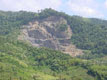
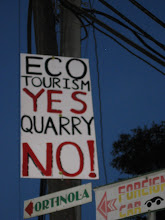
Penelope Beckles’ Order made sure that no application for quarries less than 150 acres would be subject to an Environmental Impact Assessment (EIA)! (no quarry is as big as this mind you). The result was impressive, by the end of 2007 there were 17 new applications for quarries and a withdrawal of a pending application, submitted before the Order (for a quarry in Ortinola, Acono, in the Maracas Valley, in the centre of the Northern Range).
In her haste to open the quarrying flood gates, however, ex-Minister Beckles overlooked another ‘Designated Activity’ in the CEC Rules, (8c) one for “ the clearing, excavation, grading or land filling of any area with a gradient of 1:4 or more” which also required that an Environmental Impact Assessment be performed. But no worries, up stepped Minister Dick-Ford to take care of any residual 'sustainability loopholes'.
Her December 2008 Order exempted quarrying activity from any such assessment. Again, these 'environmental hating' actions might appear astonishing to the naive but are par for the course, if one is following the leader carefully. Of course Minister Dick-Forde's Order is ludicrous as essential quarry operations are "clearing, grading, excavating and backfilling!"
Conclusion
Successive Ministers responsible for the “environment” have sacrificed declared policy and sustainability goals to serve perceived economic gains in the energy and construction sectors. The consequences of this sacrifice are profound; not only are the resources of the Northern Range being denied to future generations, not only are people living there right now suffering from reduced quality of life, but the integrity of the supposed democratic process and trust in Government institutions to look after the well being of present and future generations, are also shattered.
Truth Drummers have used the quarry sector to demonstrate ‘anti-sustainable development' with far reaching and destabilizing implications. The hypocrisy of T&T’s Government signing a ‘Declaration of Commitment’ to sustainability at the up-coming Summit while doing the opposite at home is why we will Drummit to the Summit.