Definition:
1 MW (megawatt) = 1 million joules per second = unit of electrical power generation
In Trinidad & Tobago the total rate of electricity generation is presently 1100 MW.
The existing steel mill (Arcellor-Mittal) uses 240 MW.
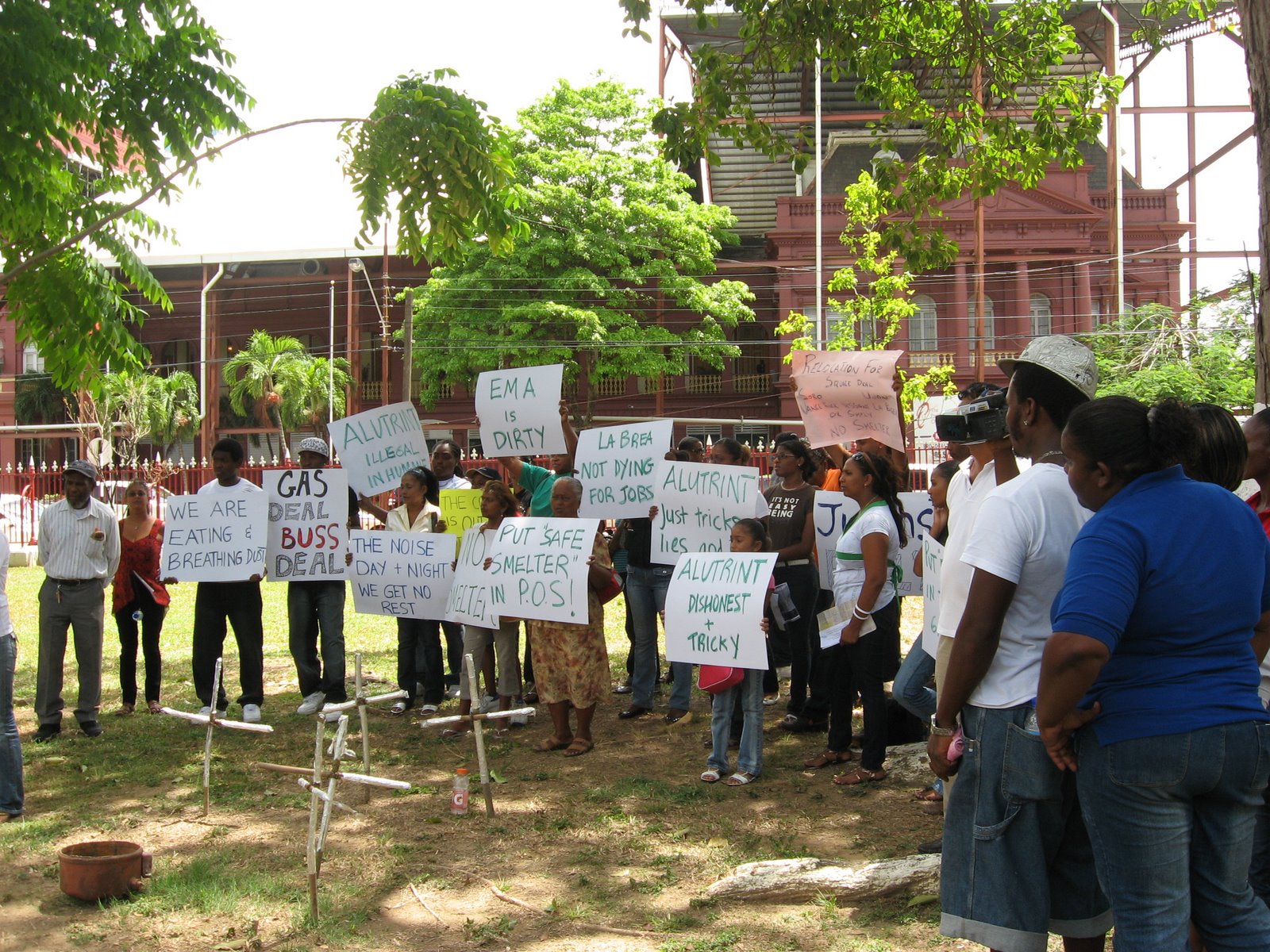
The 125 000 t/yr (tonnes per year) Alutrint aluminium smelter proposed to be built by Chinese at La Brea would use 240 MW. They are stealthily seeking to double output to 250 000 t/yr. This would require 480 MW.
A new power plant proposed for La Brea which has been granted environmental clearance by the Environmental Management Authority (EMA) is to have a capacity of 720 MW. This would serve Alutrint and other users.
The Aluminium Company of America (ALCOA) applied for environmental clearance for a 341 000 t/yr smelter at Chatham in South West Trinidad, with a statement that this would require 580 MW. T&T Prime Minister notified public in December 2006 that plans had been suspended for the smelter at Chatham.
The Essar Steel Mill proposed for Claxton Bay and approved by Environmental Management Authority would require 202 MW with space left for an additional plant requiring 240 MW.
What the above shows is that the proposed additional heavy gas based industry would require a doubling of electricity production. In T&T all electricity is generated from combustion of our natural gas. Why should we double gas consumption for heavy polluting and gas consuming industries?
Who is benefiting? Who is losing? There is no transparency in the gas supply deals (EITI rejected, see earlier post). There is no cost-benefit analysis in the Certificate of Environmental Clearance (CEC) decision making process administered by the Environmental Management Authority (EMA).
We should be looking at low energy demanding industry with low environmental impact and high valued outputs.
Showing posts with label energy security. Show all posts
Showing posts with label energy security. Show all posts
Monday, April 13, 2009


Growing the National Carbon Footprint - Carbon Dioxide
T&T presently produces approx 33 million t/yr of CO2 from fossil fuel.
Essar Steel’s approved plant would produce an additional 900 000 t/yr of CO2 initially, rising to 1 870 000 t/yr.
Adding 760 000 t/yr of CO2 production from a 240 MW captive power plant for Essar; gives us a total of 2 630 000 t/yr of CO2 .
If Essar pursues its declared interest in putting up a second mill similar to the first, its CO2 emissions would double to 5 260 000 t/yr.
The 720 MW power plant proposed for La Brea would generate 2 300 000 t/yr of CO2 . In addition, Alutrint would release greenhouse gases from the smelter rooms at a rate of up to 2 tonnes of CO2 equivalent per tonne of aluminium produced, i.e. 250 000 t/yr of CO2 equivalent.
ALCOA would cause release of as much as 2 760 000 t/yr of CO2 equivalent from smelter rooms and electricity generation.
Total additional CO2 from the proposed plants, excluding the future extensions, is estimated as an additional ‘cool’ 25%. This is global warming T&T Vision 2020 style.
Essar Steel’s approved plant would produce an additional 900 000 t/yr of CO2 initially, rising to 1 870 000 t/yr.
Adding 760 000 t/yr of CO2 production from a 240 MW captive power plant for Essar; gives us a total of 2 630 000 t/yr of CO2 .
If Essar pursues its declared interest in putting up a second mill similar to the first, its CO2 emissions would double to 5 260 000 t/yr.
The 720 MW power plant proposed for La Brea would generate 2 300 000 t/yr of CO2 . In addition, Alutrint would release greenhouse gases from the smelter rooms at a rate of up to 2 tonnes of CO2 equivalent per tonne of aluminium produced, i.e. 250 000 t/yr of CO2 equivalent.
ALCOA would cause release of as much as 2 760 000 t/yr of CO2 equivalent from smelter rooms and electricity generation.
Total additional CO2 from the proposed plants, excluding the future extensions, is estimated as an additional ‘cool’ 25%. This is global warming T&T Vision 2020 style.
Saturday, March 28, 2009
Summit in a Trough
T&T's Government has over the last couple decades advanced neoliberal economic policies consistent with the now defunct FTAA. T&T has a deregulated open market with tax exemptions, weak environmental regulations and a policy of combining privatization of strategic assets with growing state corporations - the 'Corporate State'.
Rent from the oil/gas economy and billions of foreign investment in the 'heavy gas' based industrial sector provide the illusion of near full employment and wealth. But these revenues are near spent. It is costing T&T over one-hundred milion $US to host this Summit. The decision to do so was made before the collapse of global capitalism.
• World GTL Trinidad Limited (WGTL-TL) Gas-to-Liquid plant which is a joint venture between World GTL Inc. (New York) and the Petroleum Company of Trinidad and Tobago Ltd. (Petrotrin). World GTL-Trinidad Limited will own and operate the 2,250 bpd Gas to Liquids (GTL) plant; and
• the Alutrint Smelter Complex: the capital cost is TT$1.65 billion and will produce 125,000 metric tonne per annum, all of which will be used for downstream industries.
Manning continued..."Mr. Speaker, in 2005 the Government received proposals to construct two Aluminium smelters, one by Alcoa and the other by Alutrint. An Agreement in Principle was prepared by Alcoa in November 2005, to conduct feasibility studies to explore the establishment of an Aluminium facility at Chatham/Cap De Ville. A decision in principle to relocate the proposed site of the Plant has delayed this project."
END
Rent from the oil/gas economy and billions of foreign investment in the 'heavy gas' based industrial sector provide the illusion of near full employment and wealth. But these revenues are near spent. It is costing T&T over one-hundred milion $US to host this Summit. The decision to do so was made before the collapse of global capitalism.
EVIDENCE OF ENERGY INSECURITY
No Vision, Goal, Policy or Planning documents of the Government of T&T, contain any reference to 'Energy Security' in terms of sustainability planning for the future. The only 'security' refrences are to protection of supply infrastructure from natural disasters and terrorism so that we can continue to feed the insatiable demand of USA and others.
When presenting her Letter of Credence to US Government (06/June/08) the T&T Ambassador to the USA stated "the United States also responded swiftly to the request from Trinidad and Tobago to assist in our country’s energy security initiatives through an assessment of the critical infrastructure of our energy sector, a sector which has provided, on average, some 68% of the liquefied natural gas requirements of the United States in the last six years and approximately 69% and 51% respectively of ammonia and methanol."
The Government of Trinidad & Tobago's ENERGY POLICY is best described as a "GAS RUSH".
In the local Guardian Newspaper (04/March/08) Reginald Potter, Gas Expert and Geologist, under the heading "Explain Maths on Gas Reserves" points out: "Gas contracts are based on proven reserves. Present consumption is 4.0 billion cubic feet a day or 1.46 trillion cubic feet a year. A new project will require 20-30 years of assured gas supply. If existing industries similarly demand 20 years of assured (contracted) supply we need at least 29 trillion cubic feet of proven reserves to provide that assurance for them alone.
Our proven reserves are 16.74 trillion cubic feet, or rather they were in January 2006, the effective date of the Ryder Scott report. But we have had two years of no discoveries since then so it’s probably 13 or 14 trillion as of January this year.
Furthermore, the Minister of Energy let slip in one of his speeches that the inaccessible gas shared with Venezuela is included for the first time in this audit, so taking that out there are probably 11 trillion cubic feet left. That means present proven reserves amount to about 7.5 years consumption (reserves to production ratio or R/P).
How then can the Government be pressing ahead with Essar Steel, Alutrint, AUM complex, a propylene plant, and talking to BG (about LNG “Train X?”). If these are allowed to see the light of day, our R/P ratio drops to probably five years.
Incidentally, the Ryder Scott audit is not new. It is the responsibilty of Government to do this every year but it managed to let it lapse in the hope that BP’s “Deep Ibis” well would prove some hitherto unknown vast potential for exploration. That failed.
The Ryder Scott report can be accessed online for every preceeding year and shows clearly that the reserves have always been in short supply while Government allowed new projects to take us to the present four billion cubic feet a day. The much touted “new” audit to be done is merely a continuation of the practice that has fallen two years in arrears. Audits are not a procedure for discovering gas."
Grave Concerns for Natural Gas Reserves were also expressed (18/October/06) by Kasala Kamara (political scientist, lecturer, educator, author, journalist and consultant): "While the large majority of people of Trinidad and Tobago are of the view that the country's natural gas reserves have a life span of over twenty (20) years, experts in the energy sector have been expressing grave concern not only about the adequacy of natural gas to service the heavy industrial projects planned but also how the gas is being used or exploited"..."
"...In a front page article entitled, Gas Reserves: does Trinidad Really Have Enough Gas for all its Projects? Energy Caribbean issue number 22 reported: "Is a gas shortage looming in Trinidad and Tobago that could have the effect of temporarily halting petrochemical development in particular and further possible expansion into liquefied natural gas?"Many informed analysts think this is certainly the case and the ministry of energy may be keeping the matter low-key, in order to avoid drawing too much attention to it..."
"...The National Gas Company does not of its own have significant amounts of natural gas nor does state-owned PETROTRIN. In other words, our natural gas essentially remains under the ownership and control of foreign transnational corporations whose primary goal is to extract as much as possible and fetch the best market price to facilitate achieving the goal of profit maximisation and business growth and expansion. Our long-term growth and development is not a priority."
Despite these concerns, in his 2008 Budget Speach to Parliament, Prime Minister Patrick Manning expanded the 'GAS RUSH' stating... "there are also five gas-based projects which are due to come on stream in the short term. They are:
• the Essar Steel Complex which involves the establishment of an integrated steel complex producing flat hot rolled coil as well as hot briquette iron and slabs;
• Methanol/Propylene/Polypropylene (MTP) - Discussions on Project details between Lurgi and the Government are ongoing. Basell, a joint venture between BASF and Shell is proposing a 160,000 tonne per annum plant at a capital cost of TT$9.5 billion;
• the Methanol Holdings’ AUM Complex with a proposed capacity of the plant is 1.5 million tonnes per annum of Urea Ammonium Nitrate and 60,000 tonnes per annum of Melamine: the capital cost is TT$10.1 billion;• World GTL Trinidad Limited (WGTL-TL) Gas-to-Liquid plant which is a joint venture between World GTL Inc. (New York) and the Petroleum Company of Trinidad and Tobago Ltd. (Petrotrin). World GTL-Trinidad Limited will own and operate the 2,250 bpd Gas to Liquids (GTL) plant; and
• the Alutrint Smelter Complex: the capital cost is TT$1.65 billion and will produce 125,000 metric tonne per annum, all of which will be used for downstream industries.
Manning continued..."Mr. Speaker, in 2005 the Government received proposals to construct two Aluminium smelters, one by Alcoa and the other by Alutrint. An Agreement in Principle was prepared by Alcoa in November 2005, to conduct feasibility studies to explore the establishment of an Aluminium facility at Chatham/Cap De Ville. A decision in principle to relocate the proposed site of the Plant has delayed this project."
END
Subscribe to:
Posts (Atom)